
Investing in a dental implant is a significant step toward restoring your smile, but the work doesn't end when you leave the chair. The long-term success of your implant depends on your daily care. Cleaning your implant properly isn't just about polishing the crown; it’s about meticulously cleaning the gumline, where oral health truly matters.
This requires a gentle but thorough routine using the right tools to keep plaque away from the most critical area: where the implant post meets your gum tissue. At Trinity Dental Care, we want to empower our Scottsdale patients with the knowledge to protect their investment for a lifetime.
The Real Reason Your Implant Needs Daily Cleaning
It’s true that the beautiful prosthetic crown on your implant can’t get a cavity. The real threat, however, isn't to the porcelain—it's to the living, breathing tissue that holds your implant firmly in place.
The long-term success of your investment depends entirely on keeping your gums and jawbone healthy. This comes down to a consistent daily cleaning routine that prevents harmful bacteria from taking hold.
A natural tooth is anchored by a web of tiny ligaments that give it a bit of flex and a natural defense barrier. A dental implant, on the other hand, fuses directly with your jawbone in a process called osseointegration. This creates an incredibly strong foundation, but it also means the seal at the gumline is different and more susceptible to bacteria if plaque isn't managed.
Why Your Gums Are the First Line of Defense
When plaque and bacteria are left to accumulate around an implant, they can trigger inflammation in the gums. This condition is known as peri-implant mucositis, which is essentially the implant version of gingivitis. The good news is that it's often reversible with improved home care and a professional cleaning.
However, if ignored, this inflammation can progress into a much more serious problem: peri-implantitis. This is a destructive disease that actively attacks and destroys the bone supporting your implant. If enough bone is lost, the implant can become loose and ultimately fail, requiring complex and costly intervention.
Successful implant ownership is a partnership between your daily diligence and our professional oversight at Trinity Dental Care. As your Scottsdale dentist, Dr. Christine Ann Fink and our team are your partners in making sure your smile investment lasts a lifetime.
The Importance of a Consistent Routine
Protecting your implant isn't complicated, but it absolutely demands consistency. The American Academy of Implant Dentistry reports that dental implants have an impressive long-term success rate, with studies showing rates as high as 98%. A huge reason for that number is rigorous post-operative care from patients like you.
By dedicating just a few minutes each day to meticulous cleaning, you are actively protecting the very foundation of your new tooth. For anyone just starting their implant journey, understanding these fundamentals is the first step. You can get the full picture in our guide, Your Intro to Dental Implants, for more background.
Building Your Essential Implant Care Toolkit
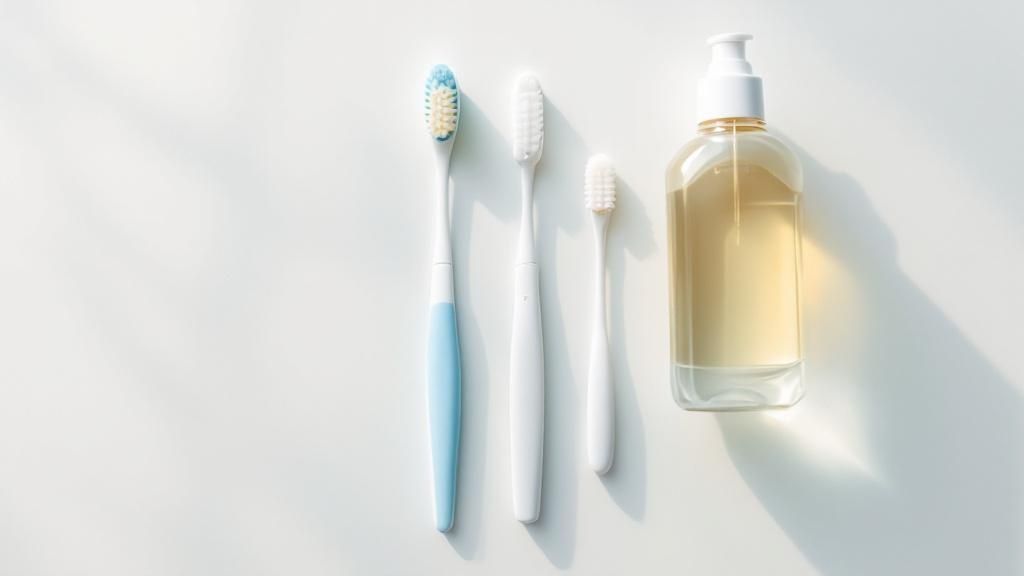
When it comes to keeping your dental implants healthy for the long haul, your old toothbrush and a quick swipe of floss won't cut it. Your implant is an investment, and protecting it requires a specific set of tools designed to clean around its unique shape without causing any harm.
Think of it this way: you wouldn't use a kitchen sponge to wash a luxury car. Assembling the right toolkit is your first—and most important—step toward years of success with your new smile.
Choosing the Right Toothbrush
The foundation of any good oral hygiene routine is the toothbrush, but for implants, the bristles absolutely must be soft. This protects both the implant crown and the delicate gum tissue that surrounds it.
- Soft-Bristled Manual Brush: A classic for a reason. With proper technique, a manual brush with densely packed, ultra-soft bristles can gently and effectively sweep away plaque.
- Electric Toothbrush: Many of our Scottsdale patients find an electric toothbrush gets the job done better. I always recommend models with a sensitive setting and a built-in pressure sensor to prevent applying too much force, which can irritate the gums around an implant.
Mastering Interdental Cleaning
That tricky space between your implant and your natural teeth, or underneath a fixed bridge, is a magnet for bacteria. Regular string floss often struggles to clean these areas properly, which is why specialized tools are non-negotiable.
A water flosser, or oral irrigator, is a fantastic addition. It uses a targeted, pulsating stream of water to flush out food and break up plaque in hard-to-reach spots. Always start on the lowest pressure setting and aim the stream at your gumline, not directly down into the gum pocket.
The goal of cleaning between your teeth isn't just to remove last night's dinner. It's to disrupt the sticky bacterial biofilm that forms every day. This is the absolute key to preventing issues like peri-implant mucositis.
Another tool I love is the end-tuft brush. It’s a small, single-tufted brush perfectly shaped to clean where the implant crown meets your gumline—a spot a regular toothbrush often misses. Its pointed design gives you incredible precision right at the base of the implant.
The Best Floss and Brushes for Implants
When it comes to flossing around an implant, the material matters. You need something that won't shred, leave behind fibers, or scratch the implant components.
- Implant-Specific Floss: This floss is cleverly designed with a stiffened end for easy threading and a spongy, thicker section that cleans the abutment and sides of the implant beautifully.
- Nylon-Coated Interdental Brushes: For wider gaps, these little brushes are perfect. The key is the nylon coating, which prevents you from scratching the titanium implant post. Never use brushes with exposed metal wires.
To make things simpler, here’s a quick-reference table of the tools we've discussed.
Your Daily Implant Cleaning Toolkit
This table breaks down the essential tools we recommend for daily implant care, what they do, and why they’re so important for protecting your investment.
| Tool | Primary Use | Why It's Essential for Implants |
|---|---|---|
| Soft-Bristled Toothbrush | General surface cleaning of the crown and surrounding teeth. | Gentle on both the prosthetic crown and the delicate gum tissue, preventing irritation. |
| Water Flosser | Flushing out debris and plaque from between teeth and around the implant base. | Reaches areas where traditional floss can't, disrupting bacterial colonies without direct contact. |
| End-Tuft Brush | Precision cleaning at the gumline where the implant crown meets the gums. | Targets the high-risk area for plaque buildup that standard toothbrushes often miss. |
| Implant-Specific Floss | Cleaning the sides of the implant abutment and under fixed bridges. | Designed not to shred or scratch implant surfaces; often has a stiff end for easy threading. |
| Nylon-Coated Brush | Cleaning wider spaces between the implant and adjacent teeth. | The protective coating prevents scratching the titanium surface, which can harbor bacteria. |
Building this personalized toolkit empowers you to take control of your implant's health. Of course, even the best home care routine needs a professional partner, as regular teeth cleanings are important for long-term success.
A Practical Daily Routine for Implant Cleaning
Consistency is the secret to protecting your dental implant investment for life. Once you have the right tools, the next step is building them into a simple, effective daily routine that safeguards your oral health.
The goal is to be both gentle and thorough. Scrubbing too aggressively can damage the delicate seal around your implant, while being too passive leaves behind harmful plaque. The best approach combines a mindful technique with unwavering consistency.
Brushing with Precision
With an implant, your brushing technique matters more than ever. Start with a soft-bristled toothbrush and a pea-sized amount of non-abrasive toothpaste. I always caution patients against abrasive formulas, like many whitening toothpastes, as they can create microscopic scratches on the implant crown.
Forget a harsh back-and-forth sawing motion. Instead, use gentle, circular strokes, angling the bristles at 45 degrees toward your gumline. This specific angle lets the bristles sweep away plaque from the vulnerable crevice without causing irritation.
This visual breaks down the core parts of a successful daily routine.
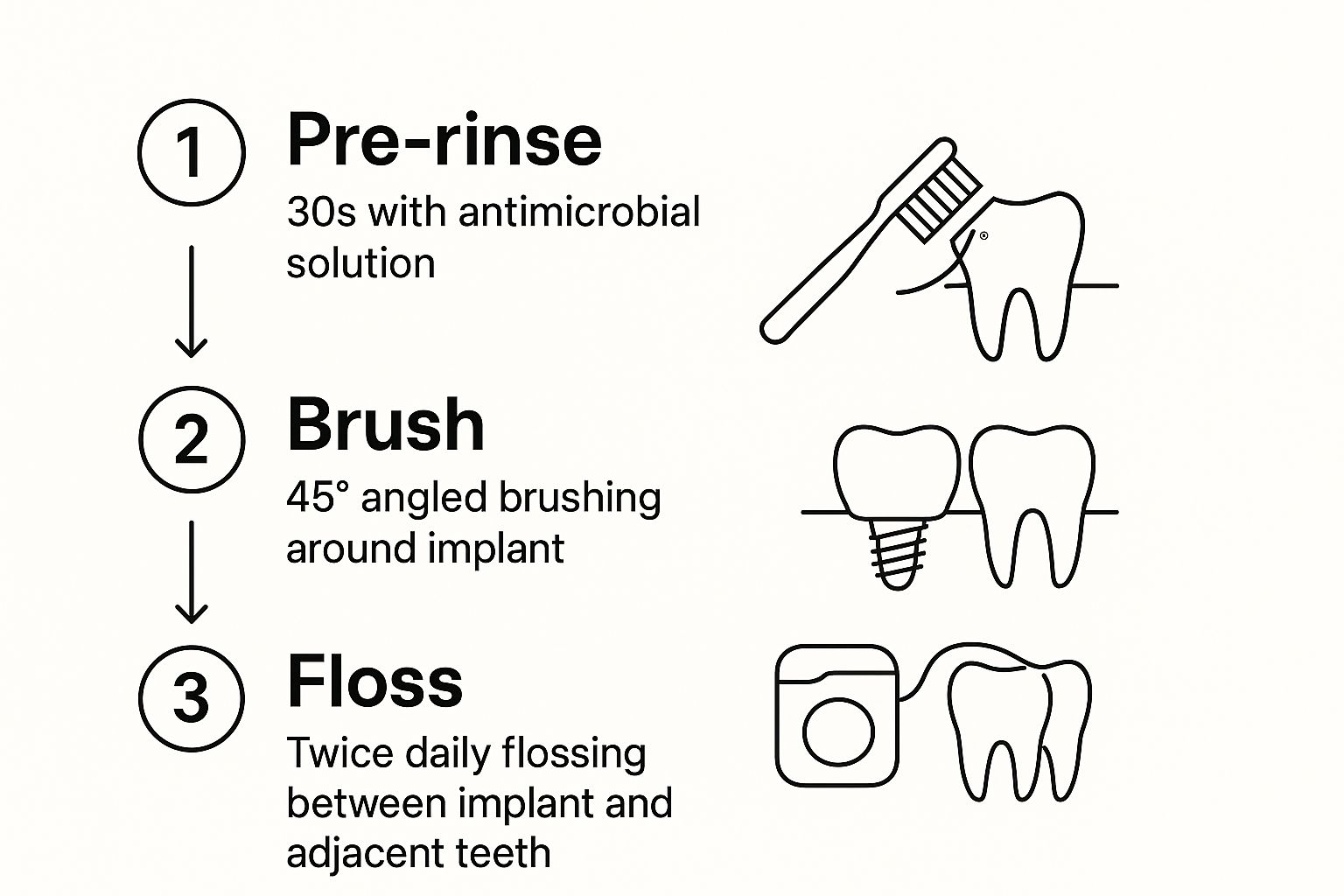
As you can see, the process flows from a preparatory rinse to targeted brushing and, finally, that all-important interdental cleaning. Together, these steps create a complete barrier against bacterial buildup.
Interdental Cleaning The Right Way
This is the most crucial part of your daily care. The area between an implant and its neighboring teeth is highly vulnerable to bacteria, making your specialized tools absolute game-changers.
- For Water Flossers: Use your water flosser on a low-pressure setting. Trace the gumline around the implant, pausing for a few seconds on the spaces between teeth to gently flush out debris.
- For Implant Floss: Gently thread the floss around the implant post. Make a "C" shape and wipe up and down against the sides of the implant abutment, moving from just below the gumline to the top of the crown.
- For Interdental Brushes: Pick a brush size that fits snugly but comfortably. You should be able to move it back and forth a few times without ever having to force it.
At Trinity Dental Care, we often tell our Scottsdale patients to think of implant cleaning like caring for a high-performance vehicle. You wouldn't skip an oil change, and you shouldn't skip interdental cleaning—it’s the essential maintenance that prevents costly problems.
Remember to clean these in-between spaces at least once per day, preferably before bed. This ensures no food particles or plaque are left to fester overnight while your natural saliva production decreases.
What Happens During a Professional Implant Cleaning
Taking care of your dental implants at home is the bedrock of their long-term health, but it's only half the battle. Think of professional maintenance as the other essential part of the equation.
A specialized professional cleaning is designed to inspect, deep-clean, and protect your implant in ways you simply can’t achieve on your own. At Trinity Dental Care, our primary focus is removing every bit of plaque and tartar without altering the implant’s smooth surface.
The Right Tools for a Delicate Job
You won’t see us coming near your implant with traditional stainless-steel scalers used on natural teeth. Instead, our hygienists are armed with instruments made from implant-safe materials that are tough on buildup but gentle on your investment.
- Titanium or Resin Scalers: These are our go-to instruments, made from materials that are either softer than or compatible with your implant's titanium. They ensure we can clean effectively without scratching the post or abutment.
- Plastic Curettes: This is another excellent, safe option for carefully removing plaque and calculus from the implant surface and just below the gumline.
A study published in the Journal of Oral Implantology found that while all instruments create minor surface changes, implant-safe plastic and titanium curettes were among the least abrasive, preserving the implant's integrity.
Advanced Technology for a Deeper Clean
Beyond our specialized hand tools, we use advanced technology to gently but thoroughly obliterate stubborn biofilm. One of our most effective methods is glycine powder air-polishing.
This technique uses a fine, low-abrasive powder mixed with air and water, creating a gentle yet powerful spray. It's fantastic for removing plaque and stains from all the hard-to-reach nooks and crannies around the implant without abrading the titanium surface or the crown.
At Trinity Dental Care, we see these professional cleanings as a crucial part of our partnership with you. It’s our chance to inspect the areas you can’t see, check the implant's stability, and catch potential issues like early-stage mucositis before they escalate.
These visits are a comprehensive wellness check for your investment. It's this level of specialized service that makes it so important to get a dental cleaning in Scottsdale with a team that truly understands implant-specific needs.
Common Implant Cleaning Mistakes to Avoid
Protecting your dental implant is just as much about knowing what not to do as it is about what you should do. Even with the best intentions, a few common habits can compromise the health of your implant.
Steering clear of these pitfalls is crucial for keeping your smile stable and healthy for years. Often, people don't realize the harm they're causing until they notice sensitivity or inflammation.
Using the Wrong Tools for the Job
One of the most frequent errors I see is patients using a toothbrush with medium or hard bristles. This is far too aggressive for an implant and can scratch the smooth surface of the crown, creating tiny imperfections that attract plaque.
Similarly, reaching for the wrong kind of interdental cleaner can cause irreversible damage.
- Avoid Abrasive Toothpastes: Whitening or "stain-removing" formulas often contain harsh particles that can permanently dull and scratch your implant crown. Stick with a gentle, non-abrasive gel or paste.
- Never Use Metal-Wired Brushes: Interdental brushes with exposed metal wires can easily scratch the titanium post of your implant. This damage is permanent and creates a breeding ground for harmful bacteria. Always choose nylon-coated brushes.
Being Too Aggressive with Your Cleaning
More pressure doesn't equal a better clean—especially around an implant. The gum tissue forms a delicate biological seal around the post, and scrubbing it too hard can cause it to recede or become inflamed.
The goal of cleaning is to gently disrupt plaque, not to aggressively scour the surface. A light touch with the right tools is always more effective and far safer for the long-term health of your gums and implant.
Being overly forceful can weaken this seal, making it easier for bacteria to get in deeper. Learning how to prevent gum disease with proper, gentle techniques is just as vital for your implant as it is for your natural teeth.
Skipping the In-Between Cleaning
Finally, the most dangerous mistake is neglecting to clean between your teeth. Simply brushing the surfaces of the implant crown isn't enough. The small spaces between your implant and adjacent teeth are high-risk zones for plaque buildup.
Skipping daily flossing—whether with a water flosser, implant-specific floss, or an end-tuft brush—leaves the most vulnerable areas undefended. This allows bacterial biofilm to flourish, leading directly to gum inflammation (mucositis) and potentially bone loss (peri-implantitis).
Frequently Asked Questions About Implant Care
It’s completely normal to have questions as you learn to care for your new dental implants. At Trinity Dental Care, we find that confident patients are the most successful. We’ve put together a few of the most common questions we hear from our Scottsdale community to provide clear, quick answers.
Can I use a regular electric toothbrush on my dental implants?
Yes, an electric toothbrush is often more effective for cleaning implants. The consistent, gentle vibrations are fantastic for disrupting plaque along the gumline. The key is to use a soft-bristled head and stick to a gentle or sensitive setting to avoid excess pressure.
How often should I have my implants professionally cleaned?
We generally advise our implant patients in Scottsdale to come in for professional maintenance and cleaning every three to six months. This is more frequent than for natural teeth because the biological seal around an implant requires specialized attention to prevent peri-implant disease. Dr. Fink will create a personalized schedule based on your oral health.
What are the warning signs of an implant problem?
Staying vigilant is key. Call us at Trinity Dental Care right away if you notice any of these signs:
- Red, swollen, or tender gums around the implant.
- Bleeding when you brush or floss the implant site.
- A persistent bad taste or bad breath.
- The implant feeling loose or shifting in any way.
- Pus or discharge coming from the implant area.
Is it safe to use mouthwash with dental implants?
Mouthwash can be a great supplement, but choosing the right one is critical. We always recommend an alcohol-free, non-staining, antimicrobial formula. Alcohol-based mouthwashes can dry out your mouth's soft tissues and cause irritation. Remember, mouthwash cannot replace the physical plaque removal from brushing and flossing.
What is the difference between regular floss and implant floss?
Implant floss is specially engineered for the unique shape of a dental implant. It usually has a stiff end for easy threading and a thick, spongy section designed to clean the wider, curved surfaces of the implant and abutment more effectively than a thin strand of standard floss.
For more answers to common dental questions, feel free to explore our comprehensive dental care FAQ section.
Partner with Trinity Dental Care for a Lifetime of Healthy Smiles
Properly cleaning your dental implants is the single most important thing you can do to protect your investment and ensure a healthy, stable smile for decades. By combining a diligent daily routine with regular professional maintenance, you can prevent complications and enjoy the full benefits of your restored smile.
Your oral health is a journey, and our compassionate team at Trinity Dental Care is here to support you every step of the way. If you have questions about your implant care or are ready to schedule your next professional cleaning in Scottsdale, AZ, we are here to help.
Contact Trinity Dental Care today to book your appointment online or call our Scottsdale office. Let's work together to keep your smile healthy and bright for a lifetime.